

Within the Horizon Europe CHEOPS-VHP-BB project, Aerospazio Tecnologie Srl contributed as an industrial partner supporting manufacturing coordination, hardware integration, and vacuum testing of key propulsion subsystems. Working alongside other consortium partners, the company contributed to various tasks within the project: validated cathode and anode building blocks, verified advanced manufacturing solutions, and executed high-power test campaigns on representative thruster platforms.
1. Aerospazio role in the consortium
Aerospazio Tecnologie Srl served as industrial integrator and test provider within CHEOPS-VHP-BB. In close collaboration with the University of Pisa (UniPi), which led design and modelling activities, and other consortium partners, Aerospazio coordinated manufacturing, assembled and integrated key hardware, and was in charge of vacuum test campaigns to validate the building blocks at subsystem and system level.
Specifically, Aerospazio activities covered:
- Stand-alone cathode vacuum testing, acceptance, and integration procedures [1]
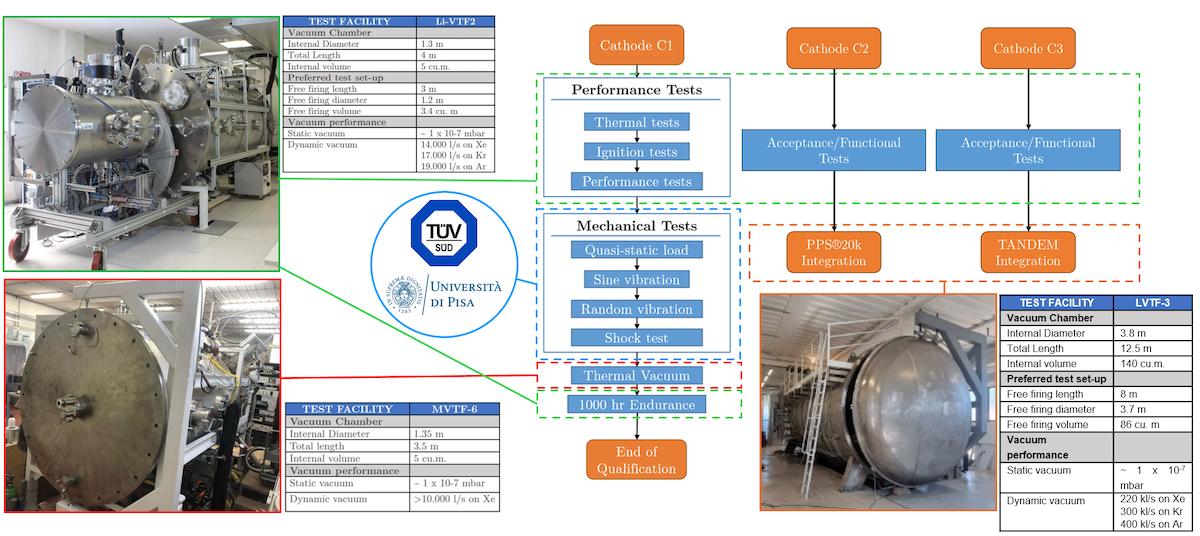
- Coordination and execution of EM cathode qualification (thermal-vacuum, mechanical, and endurance) with internal and external facilities [1,4]
- Manufacturing coordination and verification (azimuthal uniformity testing) of additively manufactured TANDEM anodes [1]
- High-power firing campaigns and cathode-thruster coupling tests on TANDEM 20 kW and Safran PPS-20k [2,3]
2. Subsystem testing and qualification
2.1. 100 A-class hollow cathode, acceptance and qualification completion
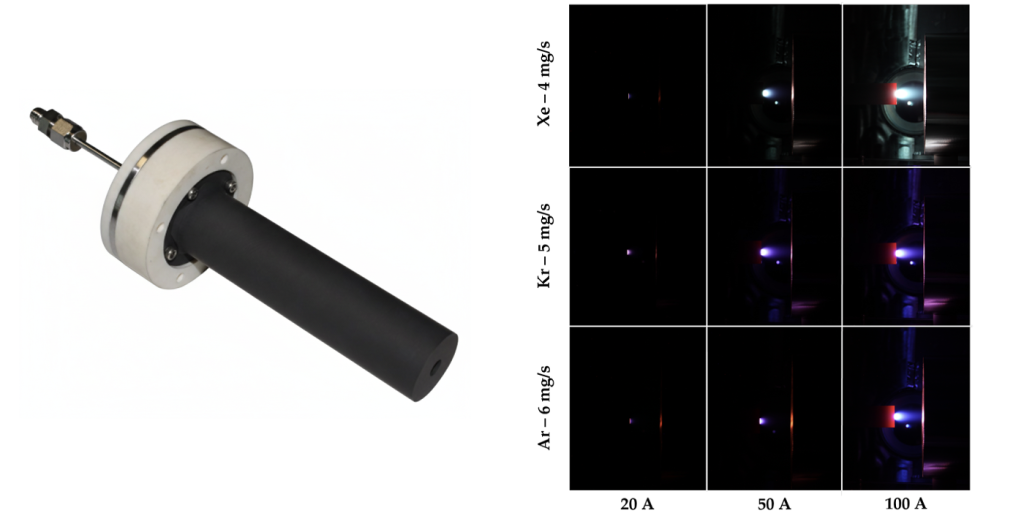
Multiple 100 A engineering-model cathodes (C1, C2, C3) were manufactured and characterised in diode mode in Xenon, Krypton, and Argon. The cathode design and modelling were performed in collaboration with UniPi, while Aerospazio executed assembly, integration, and vacuum testing.
Stand-alone acceptance testing demonstrated:
- repeatable ignitions with all propellants after 15 min pre-heating at about 250 W heater power
- discharge-current oscillations below 3% under all operating conditions
- high repeatability across all models, with I-V curves overlapping within a few volts and with deviations decreasing to < 1% at 100 A (Xe and Kr), and remaining within 5% in Argon even at low current
The cathode qualification campaign was completed, covering thermal-vacuum cycling, mechanical resilience, long-duration endurance, and integration readiness. Mechanical qualification included quasi-static loads, random vibration, and pyroshock. A 1000 h endurance run in Argon at 50 A was performed. Post-test inspections confirmed controlled erosion, minimal keeper degradation, and no emission-limiting build-up. The final assessment and qualification results will be presented in Space Propulsion 2026 [4].
2.2 LPBF anode distributors for TANDEM, production route and verification
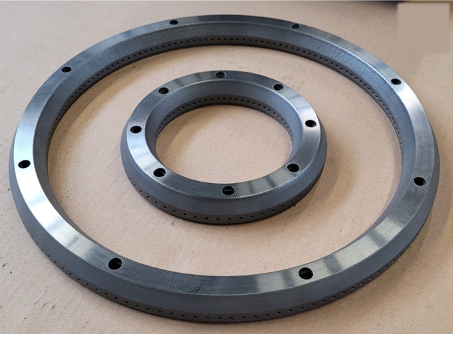
In collaboration with UniPi (design and simulation), Aerospazio coordinated the manufacturing and verification of 3D-printed anode distributors for the TANDEM thruster, targeting geometric equivalence to the original design while reducing lead time, cost, and assembly complexity.
The demonstrated outcomes included:
- State-of-the-art azimuthal uniformity: peak-to-peak deviations within ±10% in worst-case flow conditions for the outer anode
- Component integration: consolidation of multiple subcomponents into a single monolithic part.
- Total production time below 2 weeks including post-processing, at about one third of the cost compared to the original solution
- Welding seams reduced by about 90% and mass reduced by about 5%
3. High-power Hall thrusters test campaigns
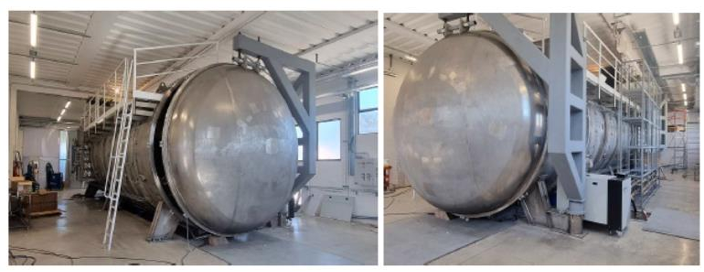
Aerospazio executed high-power firing campaigns in the LVTF-3 facility in Rapolano Terme (SI), one of the largest vacuum chambers in Europe, supporting very-high-power Hall thruster operation with advanced diagnostics. LVTF-3 had an internal volume of about 140 m³ and overall dimensions of about 3.8 m × 12.5 m, with a static vacuum level of about 1 × 10⁻⁷ mbar and dynamic pumping capability above 220 000 l/s in xenon, 300 000 l/s in krypton, and 400 000 l/s in argon. Campaigns combined thrust and performance measurements, infrared thermal monitoring, and plume diagnostics provided by Leibniz Institute of Surface Engineering (IOM) [2].
3.1. TANDEM 20 kW thruster, multi-propellant operation with CHEOPS cathode
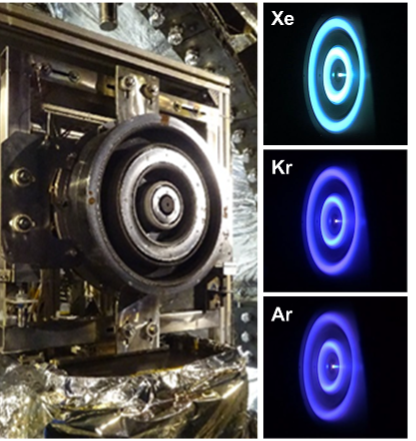
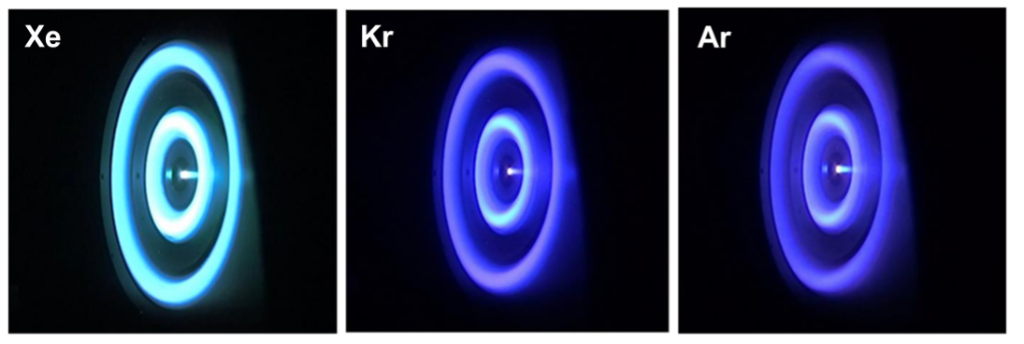
Aerospazio coupled the TANDEM nested Hall thruster with the CHEOPS high-current cathode and completed a 2025 multi-propellant characterisation campaign in xenon, krypton, and argon, covering four representative operating points from 4.5 kW to 20 kW at discharge voltages of 300 V and 400 V, in both single-channel and dual-channel configurations [2]. The campaign achieved the programme objective of demonstrating stable high-power multi-propellant operation while generating a reference dataset on performance, oscillation regimes, and thermal behaviour. TANDEM reached specific impulse values above 2 200 s in xenon and above 2 300 s in krypton within the 300–400 V envelope of this campaign, with quasi-steady efficiencies after about 1 h firing in the 50–55% range in xenon and up to about 52% in krypton [2]. It is noted that this campaign was limited to 300–400 V, while the previous TANDEM campaign demonstrated operation up to 500 V and achieved specific impulse values up to about 2 400 s in xenon [2].
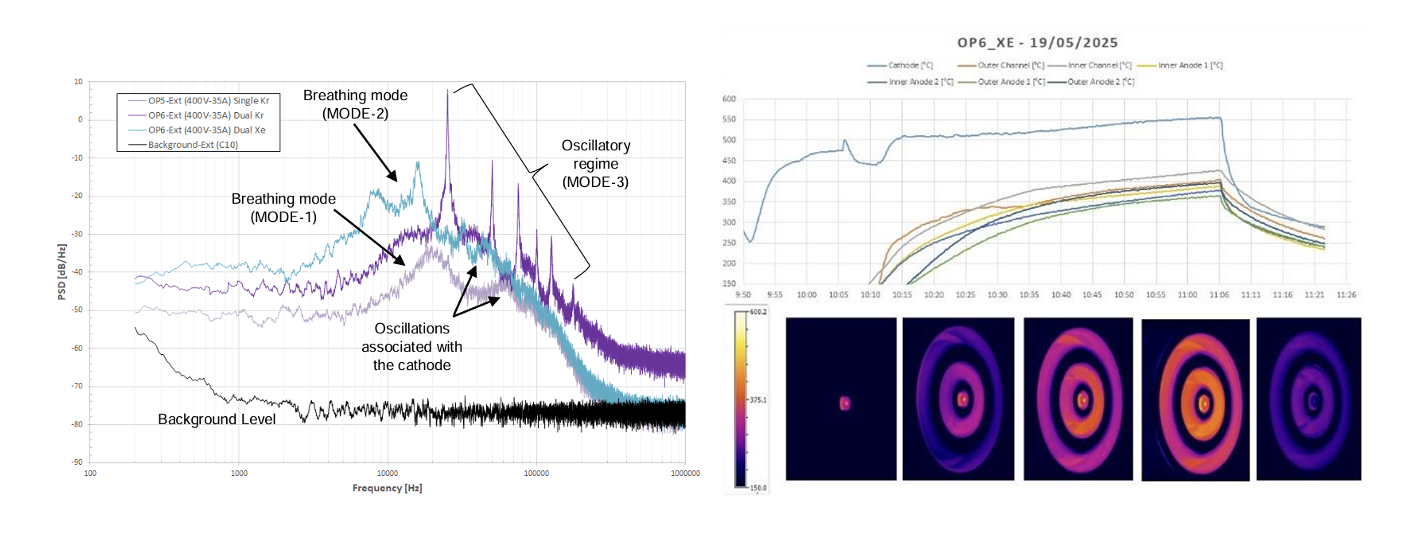
Argon operation exhibited substantially higher discharge-current oscillations and more severe thermal loading, particularly on the anodes, driving de-rating and reducing efficiencies to about 30% or less. Three distinct oscillation regimes were identified, and the results showed that transitions between regimes had a direct impact on both performance and temperatures, with the most severe oscillatory behaviour observed in krypton and argon. In xenon, oscillations showed broad spectral content around the canonical breathing-mode frequency range, whereas the highly oscillatory behaviour observed in krypton and argon was limited or absent in xenon. Additional investigations based on optical diagnostics and ultra-fast imaging were identified as a suitable next step to clarify the physical origin of these regimes and support future stability-domain extension [2].
Overall, the campaign also highlighted Aerospazio’s strength in high-power test execution, combining advanced diagnostics, rigorous data acquisition, and post-processing workflows to correlate oscillation regimes with performance and thermal maps, and to extract actionable evidence for subsequent design and operational improvements.
3.2. Safran PPS-20k technology demonstration in LVTF-3 with CHEOPS cathode
Aerospazio hosted and executed the PPS-20k technology-demonstration campaign in LVTF-3 within CHEOPS-VHP-BB, integrating advanced plume and plasma diagnostics and supporting multi-propellant operation in xenon, krypton, and argon. The campaign achieved its objectives by confirming 20 kW-class operation on all propellants, extending the explored voltage envelope (xenon and krypton up to 600 V, argon up to 425 V), and generating a comprehensive dataset for performance, thermal behaviour, and diagnostics-based model calibration. At 20 kW, thrust levels were in the ~0.9–1.15 N range with specific impulse spanning roughly ~2 100–2 600 s and total efficiencies around ~57–60% depending on propellant and voltage, while argon was demonstrated up to about 15 kW with thrust on the order of ~0.5–0.55 N, specific impulse around ~2 300 s, and total efficiency around ~40%. Facility pressure remained compatible with high-power ground-test constraints at the highest throughput points, with fixed cathode mass flow rates used during the campaign.
4. Main achievements from Aerospazio
Aerospazio Tecnologie Srl consolidated its role as an integration and test partner in CHEOPS-VHP-BB by qualifying mission-critical subsystems and demonstrating high-power operation under representative vacuum conditions.
- The 100 A hollow cathode subsystem was qualified through thermal-vacuum cycling, mechanical testing, and long-duration endurance firing, and its repeatability was confirmed across multiple manufactured units. This activity strengthened Aerospazio’s qualification capability and represented a concrete maturity step for a critical enabling component for very-high-power Hall thrusters.
- The additively manufactured anode-distributor route was validated at relevant scale, reducing lead time and cost and substantially decreasing weld count and assembly complexity. This result supported future industrial implementation of AM in Hall thruster technology, where anodes were a critical subsystem for manufacturability, cost, and the introduction of advanced internal features.
- High-power multi-propellant capability (Xe, Kr, Ar) was demonstrated through coordinated vacuum campaigns on two representative platforms, TANDEM and Safran’s PPS-20k, including cathode–thruster coupling tests. These campaigns consolidated Aerospazio’s ability to execute integrated validation of 10–25 kW-class propulsion hardware for future mission scenarios.
These results represented an important contribution to Europe’s capability to develop, qualify, and industrialise very-high-power Hall propulsion for future high-energy missions, strengthening EU autonomy in 10–25 kW-class electric propulsion technologies and their enabling subsystems.
References
- Marconcini et al., “Characterization of the TANDEM 20 kW thruster cathode and 3D-printed anodes”, IEPC-2025-634, 39th IEPC, London, 2025.
- Scaranzin et al., “Characterisation of a 20 kW dual channel HT with different propellants (Xe/Kr/Ar)”, IEPC-2025-735, 39th IEPC, London, 2025.
- Piragino et al., “Technology demonstration testing of the PPS-20k thruster”, IEPC-2025-647, 39th IEPC, London, 2025.
- Marconcini et al., “Final Technical Assessment and Qualification of the CHEOPS-VHP-BB High-Current Hollow Cathode”, Space Propulsion 2026, Paper ID 732 (accepted for oral).

