

Within CHEOPS-VHP-BB, University of Pisa (UniPi) contributed through a wide range of activities spanning architecture studies and manufacturing-driven redesign, aimed at increasing subsystem integration, reducing part count and interfaces, and advancing toward qualification-oriented requirements for high-power Hall thrusters (HTs). The following items represent a selected overview of the most significant outcomes: the assessment of non-conventional anode–channel configurations, the additive-manufacturing-driven redesign of TANDEM (UniPi, AEROSPAZIO Tecnologie srl) anodes, the investigation of ceramic additive manufacturing for functional components, and the development, supported by dedicated simulations, of a new hollow cathode engineering model compatible with both TANDEM and PPS20k.
The feasibility of innovative integrated anode–channel solutions for high-power HTs was investigated starting from a conventional architecture in which the anode and propellant distributor and the discharge channel are separate subsystems. The activity assessed integration options aimed at simplifying the overall assembly and reducing the number of parts. Three representative layouts were considered: (1) a conductive channel configuration that eliminates ceramic parts and enables a simplified anode–channel connection, while requiring electrical insulation from the magnetic circuit; (2) a ceramic channel and distributor manufactured as a single part with an embedded anode ring, enabling increased freedom in anode position and shape; (3) and a hybrid concept in which ceramic channel walls are joined to a metallic anode and distributor, primarily to reduce the height and mass of the subassembly.
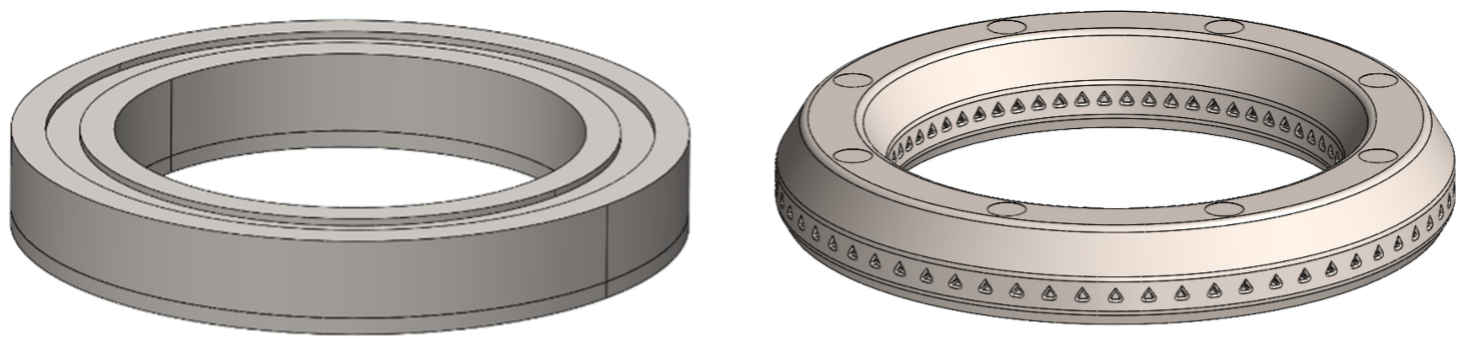
In addition, the CHEOPS-VHP-BB activity included a redesign of the TANDEM anode subsystems leveraging additive manufacturing to address two main design drivers: component consolidation and improved propellant injection uniformity. From a design standpoint, additive manufacturing is exploited to move away from multi-part anode assemblies that typically require several interfaces and joining operations, toward a more integrated architecture where propellant distribution features can be incorporated directly into the anode body. This approach is intended to reduce the overall number of parts and potential leak paths, while enabling a distribution concept aimed at achieving a more uniform neutral delivery to the discharge channel. The anodes were manufactured by laser powder bed fusion (LPBF), selected for its industrial maturity and short lead times. They were produced in AISI SS316L and implemented a radial propellant injection strategy. During the design phase, particular attention was devoted to design-for-AM aspects, with emphasis on enabling reliable powder evacuation from enclosed internal features [1]. Figure 1 shows the comparison between the two designs.
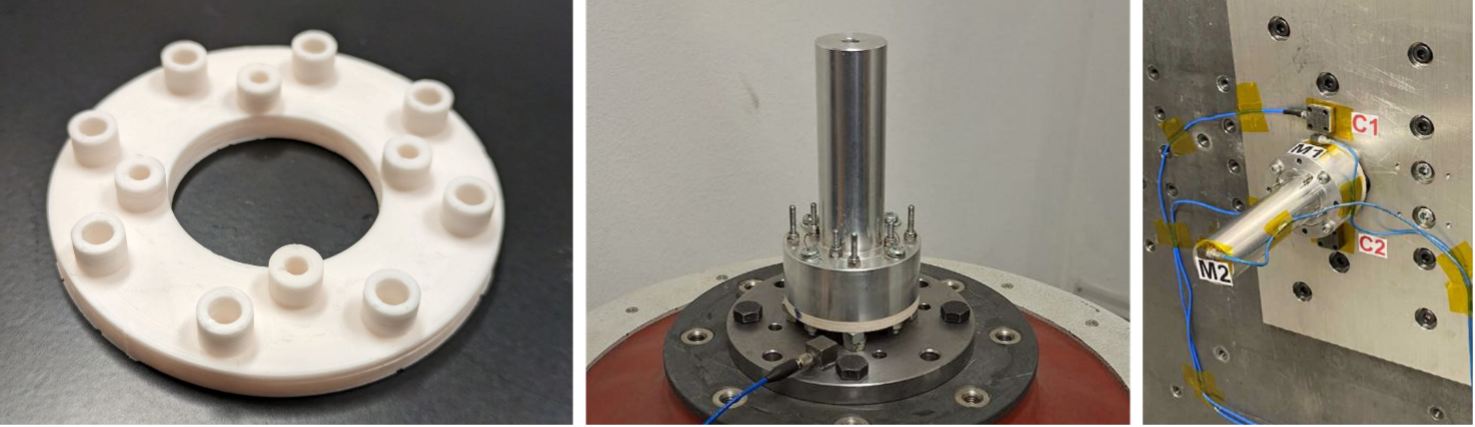
In parallel, UniPi investigated Fused Filament Fabrication (FFF) as a rapid and cost-effective route to manufacture alumina components for HT applications, addressing the high cost and long lead times typically associated with machined or conventionally formed ceramics. The adopted workflow relies on a ceramic-filled filament printed on a modified, low-cost material-extrusion platform, followed by a two-step debinding route and high-temperature sintering (1550 °C). The process achieved near-full relative density (up to 99%) and flexural strength up to 430 MPa, values comparable to commercially available alumina ceramics, while retaining shape and dimensional fidelity through predictable shrinkage compensation. Beyond material characterization, the activity demonstrated feasibility on a representative hardware item for high-power cathode systems: an alumina insulating plate manufactured via FFF for a high-current hollow cathode. The component was validated through random vibration and pyroshock tests without observed damage, providing initial evidence that FFF alumina parts can withstand conservative environmental loads relevant to launch conditions [2]. Figure 2 depicts the sintered components after fabrications and during environmental tests.
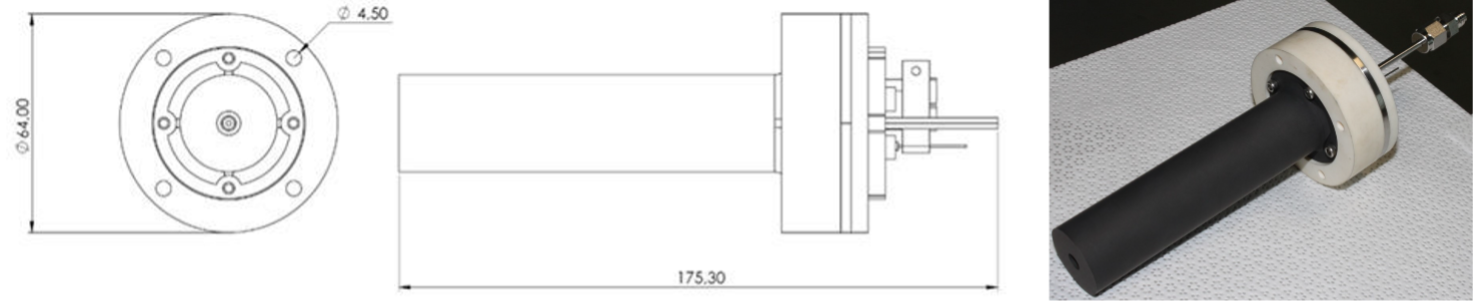
The hollow cathode for the CHEOPS project is an upgraded version of the TANDEM cathode with improvements about the capability to operate with a wide range of propellants, a reduced weight and a more robust configuration that should be able to withstand environmental tests, such as mechanical shock and vibration test, as well as endurance tests. Attention was paid to the structural and thermal analyses, and material selection [3]. Figure 3 shows the new hollow cathode EM.
Taken together, these results strengthen the design basis for more integrated, manufacturable, and test-ready high-power thruster subsystems. Next steps will prioritize design consolidation, further model-driven refinement, and extended validation testing to raise the technology readiness of the selected solutions toward qualification-oriented targets.
References
[1] Giammarinaro, G. et al. Fused filament fabrication of alumina components for Hall thrusters. Journal of Electric Propulsion 4, 18 (2025). https://doi.org/10.1007/s44205-025-00118-0
[2] Marconcini, F. et al. Characterisation of the 20 kW TANDEM Hall Thruster Cathode and 3D-printed Anodes in the Framework of the CHEOPS-VHP-BB Project. In: Proceedings of the 39th International Electric Propulsion Conference (IEPC 2025), London (2025). Paper IEPC-2025-634.
[3] Guidi, C. et al. Development of a high-current cathode for the CHEOPS VH-BB project. In: Proc. Space Propulsion 2024, Glasgow, Scotland, 20–23 May 2024. Paper SP2024_605.

